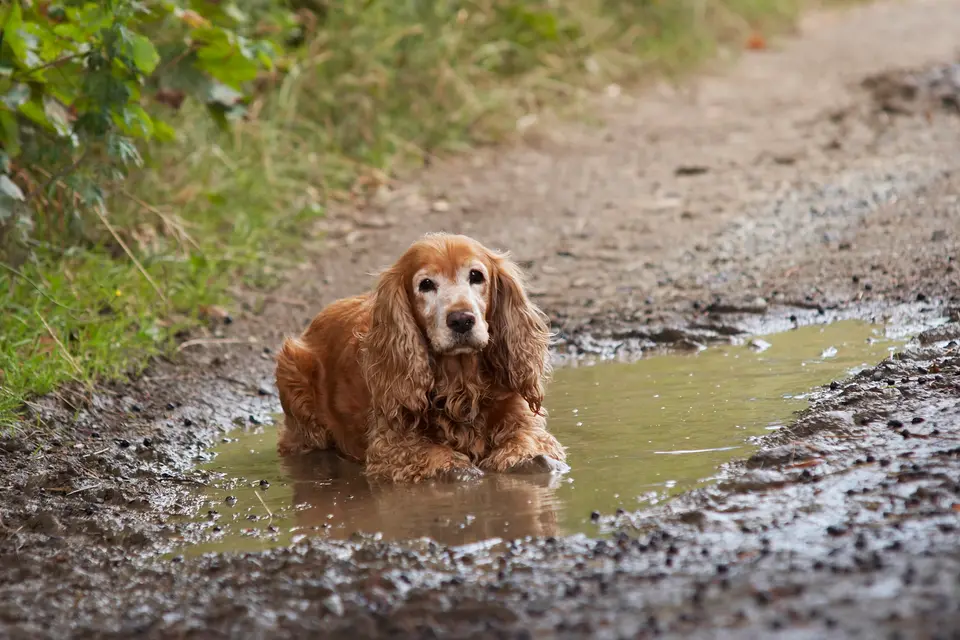
It has rained for three days straight, the backyard has turned to soup, and your dog has just come in from the last walk of the night with four brown legs, a brown belly and a look of complete satisfaction. You reach for a towel, and by the time you find one there are paw prints across the kitchen. Spring on Long Island is wonderful, and it is also the muddiest stretch of the year. Here is how we help dogs get through it with their coats, and your floors, in decent shape.
Why spring is hard on coats
The thaw and the spring rains leave lawns, parks and the edges of every walking path soft and wet for weeks. Dogs do not walk around mud; they walk through it, and low-slung dogs and dogs with feathered legs carry a good share of it home. The mud itself is not the real problem. The real problem is what happens after: wet hair that never fully dries, dirt packed down near the skin, and a coat that tangles as it dries. For long and curly coats, a few weeks of daily mud can undo a lot of good brushing.
Damp coats and mats
Hair that gets wet and then dries without being brushed out tends to clump. Mud makes it worse, because the grit works its way down toward the skin and gives the tangles something to form around. The places we see it first in spring are the same places that stay wet longest: the lower legs, the feet, the belly, the armpits and the inside of the back legs. A coat that looks fine from above can be matting quietly underneath. If your dog has a curly or wavy coat, our guide to line brushing a doodle shows how to reach those layers before they felt.
Damp hair held against the skin for long stretches is also uncomfortable, and some dogs start licking or chewing at wet spots. If you see redness, a sore or a smell that does not go away after the coat is dry, that is a question for your vet.
A routine at the door
The best spring habit is a short stop at the door before your dog heads for the couch. It takes a couple of minutes, and it saves you work later:
- Keep a towel and a shallow tub of lukewarm water by the door. Dip one foot at a time and swish gently, then towel it. Get between the toes and pads, where mud packs in.
- Wipe the belly and the legs. A damp cloth followed by a dry towel handles most of it.
- Dry, do not just blot. Rub the towel against the direction of the hair on the legs and belly, then smooth it back. A coat left damp is the one that tangles.
- Brush once the coat is dry. Brushing wet, muddy hair drags the dirt through and pulls. Let it dry, then brush out the legs and belly so tangles do not settle in.
Save full baths for when your dog is genuinely dirty. Bathing too often strips the coat and skin, and a rinse of the legs and belly is usually all spring calls for. Our article on bathing at home between grooms covers how to do it well when a full bath is needed.
Trim the feet and belly a little shorter
The single most useful thing a groom can do for a muddy spring is take the hair that touches the ground shorter. At every groom we trim the hair between the pads and tidy the feet, so there is less for mud to cling to and less to dry. If you would like, ask us to keep the belly, the inside of the legs and the feathering on the legs a little shorter for the season. You can keep the length you like on the body and the head while the parts that drag through the wet grass stay easy to wipe and quick to dry. Tell us at the start of the groom during the consultation, and we will talk through what makes sense for your dog's coat.
This is a practical choice: a dog with neat feet and a short belly is clean again in a minute, while a dog with long, feathered legs comes in carrying the yard.
Keep the groom schedule
It is tempting to put off a groom in spring with the thought that the dog will just get muddy again tomorrow. We understand the logic, but it works the other way. A regular groom is what keeps the mud manageable: the coat is clean down to the skin, the tangles are brushed out, the nails are short and the feet are tidy. Stretch the interval through a wet season and the mats that start in March are the ones we are working on in May.
Most dogs do well with a groom every four to eight weeks, and doodles do best every six to eight. Our article on how often to groom your dog breaks it down by coat type. If your dog is a heavy spring shedder too, ask about our deshedding add-on, which lifts out loose undercoat that otherwise traps dirt and moisture.
Why mobile helps in a wet season
One small advantage of grooming in your driveway: your dog does not ride across town on a rainy day, wait in a kennel, then ride home again. We bring the van to you, your dog walks from your front door to the van and back, and every dog is dried with warm air before it leaves the van, so nobody goes back inside damp. The van carries its own fresh water and power, so a wet day changes nothing about how the groom runs. We book day, evening and weekend appointments across Nassau and western Suffolk, and you can check whether we come to your town on our service area page.
A few spring reminders
- Check paws after walks for small cuts or anything stuck between the toes.
- Dry floppy ears gently with a soft towel after a rainy outing.
- Spring is also when fleas and ticks become active again. Our article on fleas and ticks on Long Island covers what a groom can and cannot do.
If your dog's coat has gotten ahead of you this spring, we are glad to help get it back on track. Send a request through our contact page or call us at 516-406-6287, and we will find a time that works.