You run your hand down your doodle's back and the coat feels soft and fluffy, so you brush the top, it looks great, and you call it done. Then the groomer parts the hair behind the ears a few weeks later and finds a felted pad sitting right against the skin. We see this almost every week. The coat on the surface was brushed; the coat underneath never was. The fix is a technique called line brushing, and once you learn it, it changes how your doodle's grooms go.
What line brushing actually means
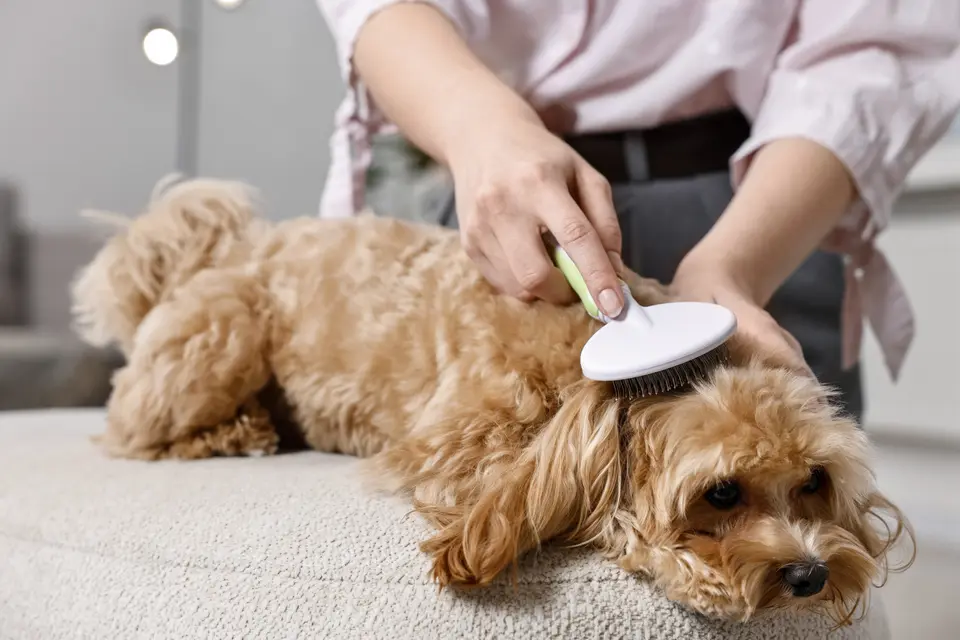
Line brushing is a way of brushing in sections so the brush reaches the skin instead of skimming the fluff. You hold back most of the coat with one hand, which exposes a thin line of hair at the base, brush that line out completely, then let a little more hair down and repeat. You work in rows, like turning pages, until you have covered the whole dog. It is slower than brushing the surface, and that is the point: a doodle's coat hides tangles under a smooth top layer.
The two tools you need
You do not need a drawer full of gadgets. Two tools do the job:
- A slicker brush. Fine wire pins on a flat or slightly curved pad. This does the work of separating the hair in each line.
- A metal comb. A sturdy steel comb with wide and narrow teeth. This is your test. If the comb glides from the skin to the tips, that section is done. If it snags, it is not.
Use the slicker with a light hand. Pressing hard scrapes the skin, and a dog who links the brush with a sore spot starts dodging it. Our brush guide covers the different tools in more detail if you are shopping.
Step by step
- Start with a calm dog on a non-slip surface. A bath mat on the floor works well, ideally after a walk.
- Begin at a leg, low down. Starting at the bottom of a leg and working up lets you build rows naturally. Hold the coat above your working spot up and out of the way with your free hand.
- Brush the exposed line from the skin out. Slicker first, in short strokes, moving away from the skin. Then follow with the comb.
- Comb to check. Slide the comb in at the skin and draw it out to the tips. Smooth means move on. A snag means more slicker work on that spot.
- Let down the next row and repeat. Move up the leg a half inch at a time, then onto the body, the chest, the tail and the head.
- Finish with a full comb-through. When you think you are done, run the comb through the whole dog once more. You will usually find a spot or two you missed.
Where mats hide
Mats form wherever hair rubs, stays damp or gets ignored. On doodles, these are the places we find them most often, and the places worth extra attention every single session:
- Under the collar or harness. Constant friction twists the hair. Take the collar off to brush this area properly.
- The armpits. Every step rubs this hair together, and it is easy to skip because the dog keeps its legs tucked. Lift each front leg gently and brush the inside.
- Behind and under the ears. The hair here is fine and soft, and it felts quickly. Check the ear flaps themselves too.
- The legs, especially the backs and insides. Wet grass, puddles and sitting all work against this hair.
- The belly and the area where the back legs meet the body. Dogs rarely love having it brushed, so it often gets left.
- The tail and the hair around it. Easy to forget, quick to tangle.
How long it takes
Be honest with yourself the first time: a full line brush on a doodle who has not had one in a while takes a good while, and you may need to split it over two sittings so neither of you runs out of patience. Once the coat is in good shape, keeping it there goes much faster, because you are mostly confirming that each section is already clear. A few short sessions a week beats one long battle on the weekend. Most adult doodles do best with brushing several times a week and a professional groom every six to eight weeks, and you can read more about why in our article on doodle coat care.
Keep each session pleasant. Talk to your dog, offer a treat for standing still, and stop before your dog starts to wriggle. Ending on a calm note makes the next session easier.
What to do when you hit a mat
When the comb stops at a knot, slow down. A small tangle can often be worked loose: hold the hair between the mat and the skin with your fingers so the pull goes into your hand and not into your dog's skin, then pick at the outer edge of the tangle with the end of the comb or the slicker, a little at a time, working inward. If it loosens, comb it through and move on.
If it does not loosen, stop. A tight mat that sits flat against the skin is not something to fight at home. Please do not cut it out with scissors. The skin lifts into a mat as you pull on it, and it is far too easy to cut the dog. Tugging at it hurts and teaches your dog to hate the brush. Note where it is and tell us when you book. Dematting takes time and care, and comfort comes first, so a matted coat is a $30 add-on, and when a coat is too matted to brush out, a shorter clip is the kind thing to do. Our article on matted coats explains what we do and why.
Why it is worth the effort
Line brushing at home is the difference between a groom where your doodle keeps the length you asked for and one where we have to go short to get under the mats. It also gives you a regular look at your dog's whole body, and a well-brushed doodle has a more comfortable session in our van.
If you would like us to show you the technique on your own dog, just ask at your next doodle groom; we are happy to walk you through it at the door. To book, send a request through our contact page or call us at 516-406-6287.