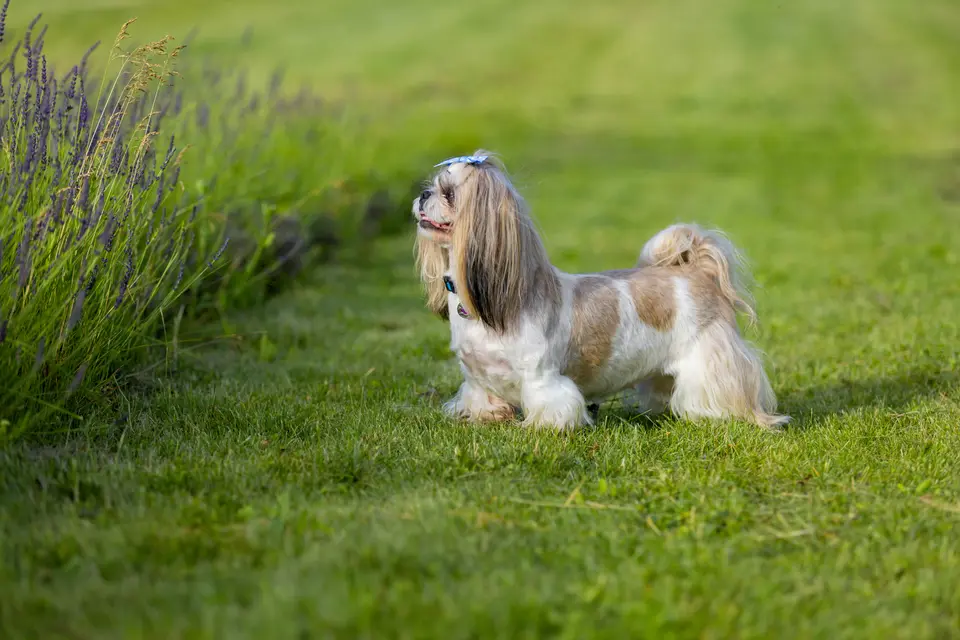
It usually starts with the face. Your Shih Tzu looks up at you from the couch and you realize you can barely see her eyes, or your Yorkie comes in from the yard with a twig woven into the hair under his chin, or your Maltese has a rusty streak running down from each eye that was not there last month. Long-coated small breeds are some of the sweetest dogs we groom, and they wear a coat that is closer to human hair than to fur. It keeps growing, it tangles easily, and it needs more attention than most owners expect when they bring a little dog home.
Why these coats are different
Shih Tzus, Yorkshire Terriers, Maltese and Havanese all have long, fine coats that shed very little. On a shedding dog, dead hair falls out and lands on the floor. On these breeds, much of the loose hair stays in the coat, where it tangles with the hair still growing. Leave it for a week or two and a tangle becomes a knot, and a knot becomes a mat sitting tight against the skin.
All four knot in the same places: behind the ears, under the collar, in the armpits, on the belly, around the tail and between the toes. Those are the spots where the coat rubs against itself or against a harness every time the dog moves.
Daily brushing is the whole game
We say it to every long-coated small breed owner: a few minutes a day beats a long session once a week. Once it is a habit, a full brush-through takes about five minutes.
- Brush in layers. Lift the top hair with one hand and brush the hair underneath, working from the skin outward. Brushing only the surface leaves the mats hiding underneath.
- Finish with a comb. If a metal comb slides from the skin to the tip without catching, that section is done. If it catches, there is a knot to work out gently.
- Check the friction spots. Behind the ears, the armpits and under the collar or harness need a look every day.
- Be gentle with knots. Hold the hair near the skin so you are not pulling on it, and pick the knot apart a little at a time. If it will not loosen, leave it for us rather than cutting near the skin with scissors.
Our guide to brushes by coat type covers the pin brush, slicker and comb these breeds need.
The face and the eye area
The face takes the most care on these breeds. Hair grows up from the nose and down from the forehead, and on a Shih Tzu or Maltese it can grow right into the eyes. Hair that pokes the eye all day is uncomfortable, so keeping it trimmed or tied up off the face matters for comfort as much as for looks.
Many light-coated small dogs also show reddish-brown staining under the eyes, and the hair there can stay damp and collect debris. Wiping gently with a soft, damp cloth once a day helps keep the area clean. At every groom we tidy the hair around the eyes carefully, with the dog held still and the blades pointed away from the face. If you notice the eyes look red, cloudy or squinty, or there is thick or colored discharge, that is a question for your vet, not something to wait on until the next groom.
The beard and mustache collect food and water at every meal. A quick wipe after eating keeps them from getting crusty and matted, and a shorter beard is much easier to keep clean.
Puppy cut or long coat?
This is the big decision, and there is no wrong answer, only the one that fits your life.
The puppy cut
A puppy cut takes the body to an even, short length, usually leaves the legs a little fuller, and rounds the face. It is by far the most popular choice for family pets, because it is so much easier to live with. Brushing takes minutes, mats have less chance to form, and the dog stays cooler in summer. Tell us the length you like, or show us a photo.
The long coat
A long, flowing coat is beautiful on all four of these breeds, and some owners love it. It is also real work. A long coat needs thorough brushing every single day, regular baths to keep it from tangling, and a topknot or careful trim to keep hair out of the eyes. If you choose it, the grooming schedule has to keep up. If life gets busy and the brushing slips, a long coat can mat quickly, and at that point the kindest option is usually to take it short and start over.
How often to book a groom
For most long-coated small breeds in a puppy cut, a full groom every four to six weeks keeps the coat at a manageable length and catches small knots before they turn into mats. A dog kept in a long coat often needs to be seen more often. Between full grooms, a mini groom keeps the face, feet and sanitary areas tidy and the dog fresh. Our guide to how often to groom your dog goes into the timing in more detail.
Prices are set by weight and coat. Most of these little dogs fall in our smallest weight band, and you can see the starting prices for mini and full grooms on our pricing page. If the coat has matted, the matted coat add-on is $30, and an impacted coat, matted solid down to the skin, starts at $50, because removing it safely takes time. Regular grooming is the simplest way to avoid both.
What happens in the van
In our van, your dog is the only animal inside. One certified groomer handles the bath, warm air drying, haircut, nails and ears from start to finish, a few steps from your front door. Every groom ends with a quick report on anything we noticed about the skin, coat, ears or eyes. You can read the full list on our dog grooming page.
If your little one is due for a trim, or you are trying to decide between a puppy cut and a longer coat, we are glad to talk it through. Send us a request or call us at 516-406-6287, and we will find a time that works for you and your dog.