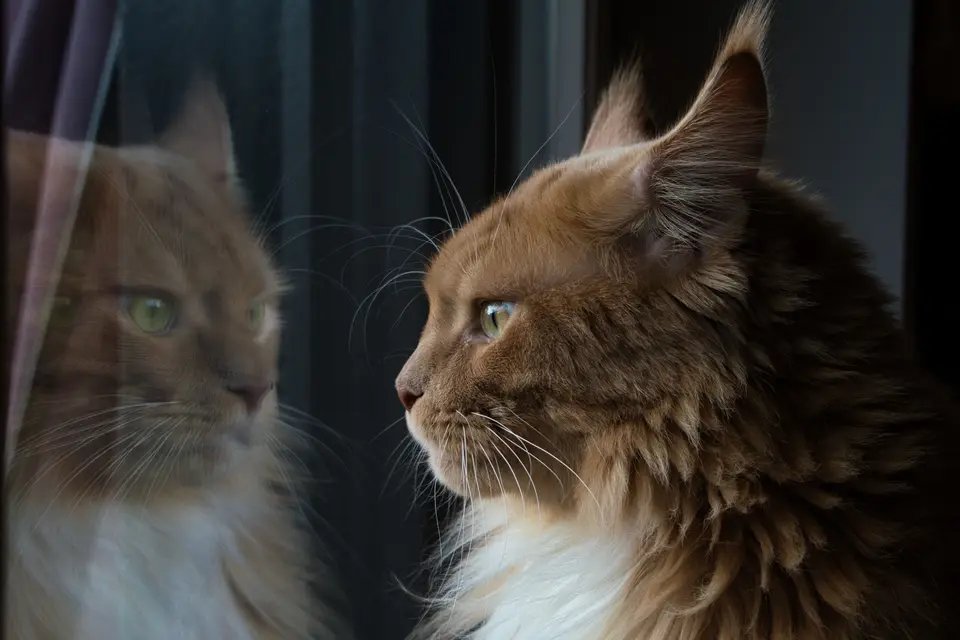
You reach down to pet your Maine Coon and your fingers land on something that does not belong there: a hard little lump of fur tucked behind the ear, or a flat, felted patch under the front leg. You try to work it loose and the cat turns, flattens her ears and walks away. That small knot is the most common thing we see on long-haired cats, and it is the start of most of the grooming problems their owners call us about. Persians, Maine Coons, Ragdolls and other long-haired cats wear beautiful coats, and those coats need more help than a cat's tongue can give.
Why a self-grooming cat still gets mats
Cats spend a lot of their day grooming, and a short-haired cat often keeps itself in good shape. A long coat is a different job. The tongue smooths the surface, but it cannot reach through a deep coat to the skin, and it cannot comb. Loose undercoat that is not removed stays in the coat, tangles with the hair still growing, and slowly tightens into a mat.
Coat type matters too. A Persian's dense, fine undercoat mats most easily. A Maine Coon's heavy, shaggy coat is longest on the belly and britches. A Ragdoll's silkier coat has less undercoat but still knots, especially when the seasons change.
Where mats form
Mats start where the coat rubs or where the cat cannot easily reach:
- Behind the ears and at the base of the skull
- In the armpits and on the inside of the front legs
- Along the belly and the inside of the back legs
- Around the hindquarters and the "britches" at the back of the thighs
- Under a collar, if the cat wears one
- Down the back and toward the base of the tail, especially on older or heavier cats
Why mats hurt cats
A cat's skin is thin and loose, which is exactly why mats are such a problem. A tight mat pulls on that skin every time the cat moves, walks or lies down. Cats are very good at hiding discomfort, so you may not see much more than a cat who avoids being touched in certain spots or stops grooming an area. Mats also trap moisture, dirt and dander against the skin, and the skin underneath can become sore or irritated without anyone seeing it.
It is also why you should never try to cut a mat out with scissors at home. Because cat skin is so thin and the mat sits right against it, it is very easy to cut the skin along with the hair. If you find a sore, a scab, a wound or a smell under a mat, that is a question for your vet.
Brushing at home
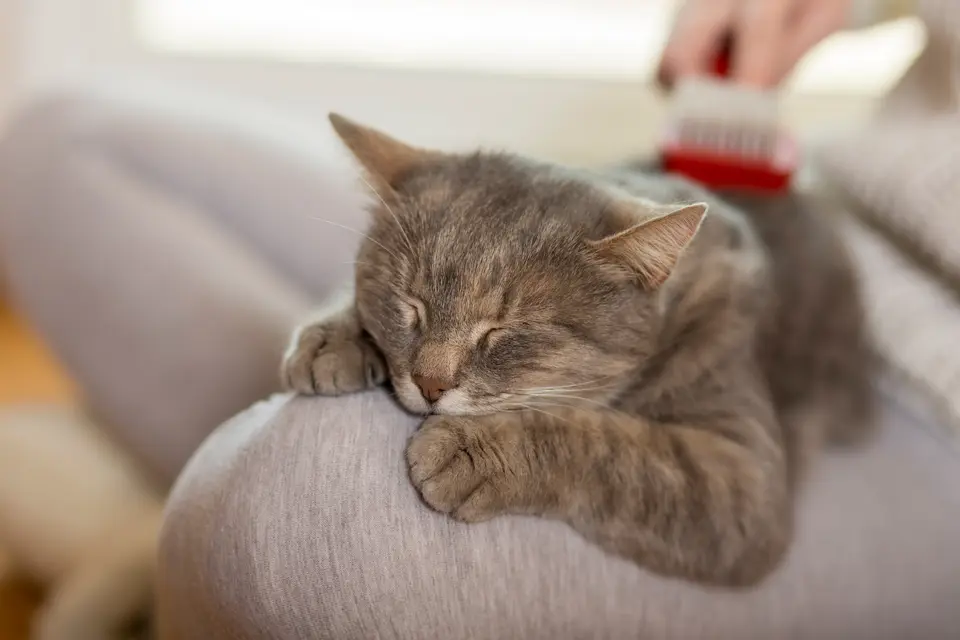
The best defense against mats is a few minutes of brushing on most days, done before a mat has a chance to form. Some tips from our groomers:
- Use a wide-toothed metal comb first, then a finer one. A comb finds tangles that a brush skims over.
- Work in short sessions. Many cats tolerate two or three minutes much better than ten. Stop before the cat gets annoyed, and try again later.
- Start with the easy spots, the back and sides, and work toward the armpits and belly a little more each time.
- Hold the fur at the base when you meet a small tangle, so you are not pulling on the skin, and tease it apart slowly.
- Leave the tight ones for us. A mat that is flat against the skin is not something to fight with at home.
Sanitary areas
Long fur around the hindquarters can collect litter and waste, which is unpleasant for you and uncomfortable for the cat. A small sanitary trim around the area keeps the cat clean without touching the rest of the coat. If your cat has ongoing trouble keeping that area clean, or you notice diarrhea or changes in the litter box, mention it to your vet.
When a shave-down is the kinder choice
We would always rather keep a long-haired cat's coat. A healthy coat is the cat's insulation and part of what makes it look like itself. But when mats cover much of the body, picking each one apart would mean an hour or more of pulling on sore skin. In that case, clipping the coat short is far gentler, and the coat grows back clean and soft.
We will always talk to you before we shave a cat, explain what we found and why, and never do it just because it is faster. A coat that has matted is a $30 add-on, and an impacted coat, matted solid down to the skin, starts at $50, because doing it safely takes time and care. A regular grooming schedule is the best way to keep a cat from ever reaching that point.
What our long hair cat groom includes
Our long hair cat groom is $165, plus tax. It includes:
- A full brushout
- A waterless bath, worked through the coat and then brushed and toweled out
- Nail trimming
- Ear cleaning
- A light fragrance
- Teeth brushing and breath spray
We do not dunk cats in a tub. Very few cats tolerate it, and the waterless bath leaves the coat clean and soft without soaking the animal. Our article on why cats do better in a mobile van explains how it works, and our cat grooming page has the full details. If a short-haired cat needs a haircut, long hair pricing applies.
How often to book
Many long-haired cats do well with a professional groom every six to eight weeks, with brushing at home in between. Persians and cats who mat easily often benefit from a shorter gap. We are happy to suggest a schedule after we have seen your cat's coat.
Calm, quiet, one cat at a time
You carry your cat a few steps from your door, your cat is the only animal inside, and one certified groomer works patiently from start to finish. If your cat has a history of biting or panicking when handled, tell us when you book so we can plan for it; our pricing page lists the $50 special handling fee that covers the extra time.
If you have found a knot behind an ear or under a leg, it is a good time to get ahead of it. Request a cat groom or call us at 516-406-6287, and we will bring the van to your driveway.