Most of us know we should be brushing our dog's teeth. Fewer of us actually do it, and the usual reason is not laziness. It is that the first attempt went badly: the dog clamped its mouth shut, the toothbrush ended up on the floor, and everybody decided it was not worth the fight. We understand, and we also think it is worth a second try, because the version of tooth brushing that works is slower, shorter, and far less dramatic than most people imagine. At Purrfect Paws Mobile Pet Spa we offer tooth brushing as an add-on to any groom, and we would still rather you brushed at home too. Here is a routine you can keep.
Why it matters
Plaque forms on a dog's teeth the same way it forms on ours, and if it is not brushed away it hardens into tartar along the gumline. Tartar irritates the gums, the gums pull back, and over time that is how dogs lose teeth and end up with sore mouths. Bad breath is the first sign most owners notice, and it is worth taking seriously rather than treating as something dogs simply have. A dog with a sore mouth often eats more slowly, drops food, chews on one side, or stops wanting to pick up toys, and a dog cannot tell you any of that in words. Brushing is the one thing that reliably slows the whole process down.
Dog toothpaste only
This is the one rule with no exceptions. Human toothpaste is not safe for dogs. It is made to be spat out, and a dog swallows whatever goes in its mouth. Use a toothpaste made for dogs. They come in flavors dogs like, poultry and beef being the usual ones, which turns the exercise from a chore into something closer to a treat. If you run out, brushing with a damp brush and no paste is fine; brushing with your own toothpaste is not.
For the brush itself, a soft small-headed dog toothbrush works for most dogs. A finger brush, which slips over your fingertip, is easier for small dogs and for the first few weeks with any dog, because it feels more like being petted than being worked on.
Start slowly, and stop before the dog wants you to
The mistake almost everyone makes is going straight to a full brushing on day one. Think of the first two weeks as teaching, not cleaning.
- Days one to three: let your dog lick a little toothpaste off your finger. That is all. Once a day, and make a fuss afterward.
- Days four to seven: with toothpaste on your finger, lift the lip gently and rub along the outside of the front teeth for a few seconds. Stop while the dog is still relaxed.
- Week two: introduce the brush or finger brush, same spot, same few seconds. Work back along the side teeth as the dog allows.
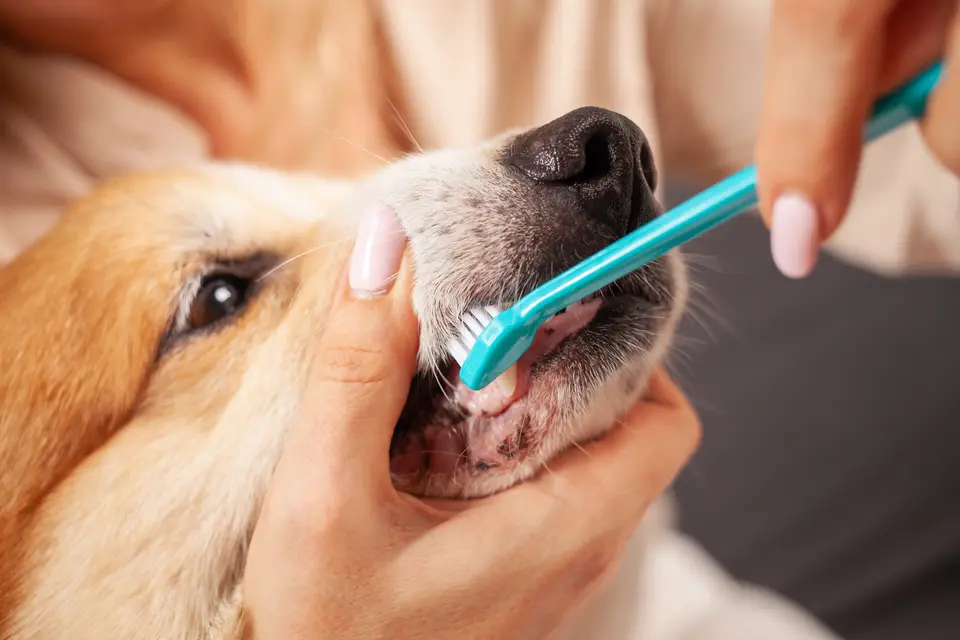
- From week three: you are brushing. Lip lifted, brush angled toward the gumline, small circles along the outside surfaces of the teeth. The outside is where most tartar builds, so if your dog never lets you do the inside surfaces, you are still doing most of the good.
Keep every session short, under a minute to begin with, and end on a good note with a treat or a game. A dog who learns that brushing is brief and ends well will let you do more each week. A dog who was pinned down for a five-minute scrub on day one will remember it for years.
A few times a week is enough to keep
Daily brushing is the ideal. For most households it is not realistic, and a routine you keep beats a perfect one you abandon. Three or four times a week makes a real difference and is a target most people can hold. Tie it to something you already do every day, like the evening walk or the last bathroom break, so it does not depend on remembering. Keep the brush and paste where you will see them. If you miss a few days, just pick it back up.
Puppies are the easiest to start, because they have not yet decided what is normal. An older dog who has never had it done can still learn; it just takes more patience at the first two steps.
What the tooth brushing add-on is
Tooth brushing is a $25 add-on to any dog groom with us, and free on your first groom if you are new to us. At the end of the groom, once your dog is clean, dry, and settled, we brush the outside surfaces of the teeth with a dog-safe toothpaste, gently, and we stop if a dog is not comfortable with it. It is a good way to see how your dog takes to having its mouth handled before you start at home, and for a dog groomed every six to eight weeks it adds a regular, thorough brushing to whatever you manage in between. It is included as standard in our cat grooms. You will find it with the other add-ons under the extras section of our services page and on the pricing page.
One honest limit: a groomer's brushing removes plaque. It does not remove tartar that has already hardened onto the teeth, and nothing you or we do with a toothbrush will. That is a job for a vet.
Breath spray and other helpers
Dog breath sprays and water additives freshen the mouth, and we use a breath spray to finish a cat groom. They are a pleasant extra. They are not a substitute for brushing, and a spray that makes the breath smell fine does not mean the teeth are fine. Dental chews and chew toys help in the same supporting way, by scraping at the teeth as the dog works on them; choose ones sized for your dog and ask your vet if you are unsure which are safe.
When to ask a vet about a cleaning
Brushing at home and brushing in the van both keep a healthy mouth healthy. They do not fix a mouth that has already gone wrong. Ask your vet about a professional dental cleaning if you notice any of these:
- Breath that stays bad despite regular brushing
- Yellow or brown buildup on the teeth that brushing does not shift
- Red, swollen, or bleeding gums
- A loose, broken, or discolored tooth
- Drooling, pawing at the mouth, or chewing on one side
- Reluctance to eat hard food or pick up toys
If we notice any of these during a groom, we will mention it in the general health observation we give you at the end of every visit, and the next step is a vet appointment rather than a toothbrush. Start small this week: a fingertip of dog toothpaste, a happy dog, and a habit that is easy enough to keep. And if you would like us to do the brushing on your next visit, just add it when you book.